MME Spring 2025, Article #1
by Ryan Shaw
Government Relations Coordinator
Introduction
Policymaking in arts education is rarely able to garner widespread attention and support. Instead, arts education policy making is often an indirect result of other education policy work, with arts education advocates capitalizing on adjacent efforts to make strides. For example, arts education was not originally included in the 1990s push for national standards (Elpus, 2013). However, after some advocacy work, the arts were added and the 1994 national standards in the arts were the first to be completed, setting off a wave of state-level arts standards adoption (Elpus, 2013; Koza, 2010; Schmidt, 1996).
Moreover, where arts education policy is purposefully passed, it is often in situations where stakes are low and political capital is not being spent. For example, recent policy success in the arts education sphere has included state-level recognition for graduating high school seniors in the form of “diploma seals” (Shaw, 2023). Similarly, lawmakers may be amenable to cost-free, symbolic proclamations like recognizing “Music in Our Schools Month” or signing onto bills that would “urge” the use of Title I funds on the arts (Americans for the Arts, 2021).
In other words, policy with more “teeth”—in the form of significant government funding for the arts in schools, or with increased regulation around what arts education schools must provide—is harder to achieve. Major expenditures for arts education have mostly occurred in recent years only when private monies are combined with public dollars (Shaw & Bernard, 2023). Also, the trend has been, if anything, for regulation to roll backward, allowing school districts more local control and choices over the provision of arts education.
For example, 45 states had an instructional requirement for elementary school arts education in 2014 (Arts Education Partnership, 2014). By 2024, this was down to only 42 states (Arts Education Partnership, 2024). Requiring the provision of arts education can be costly, and rarely do policymakers seem willing to propose significant policy as a result of the costs.
Given these stipulations, any significant state appropriations for arts education are worthy of attention. Recent successes in this vein include California’s Proposal 28 (hereafter, Prop 28), Oklahoma’s “Essential Arts Education Grants for Schools” program, Florida’s “Early Childhood Music Education Incentive Program,” and Michigan’s pilot appropriations line item to fund the hiring of elementary music teachers. In the rest of this short article, I briefly explain the format of a few such appropriations efforts.
Michigan
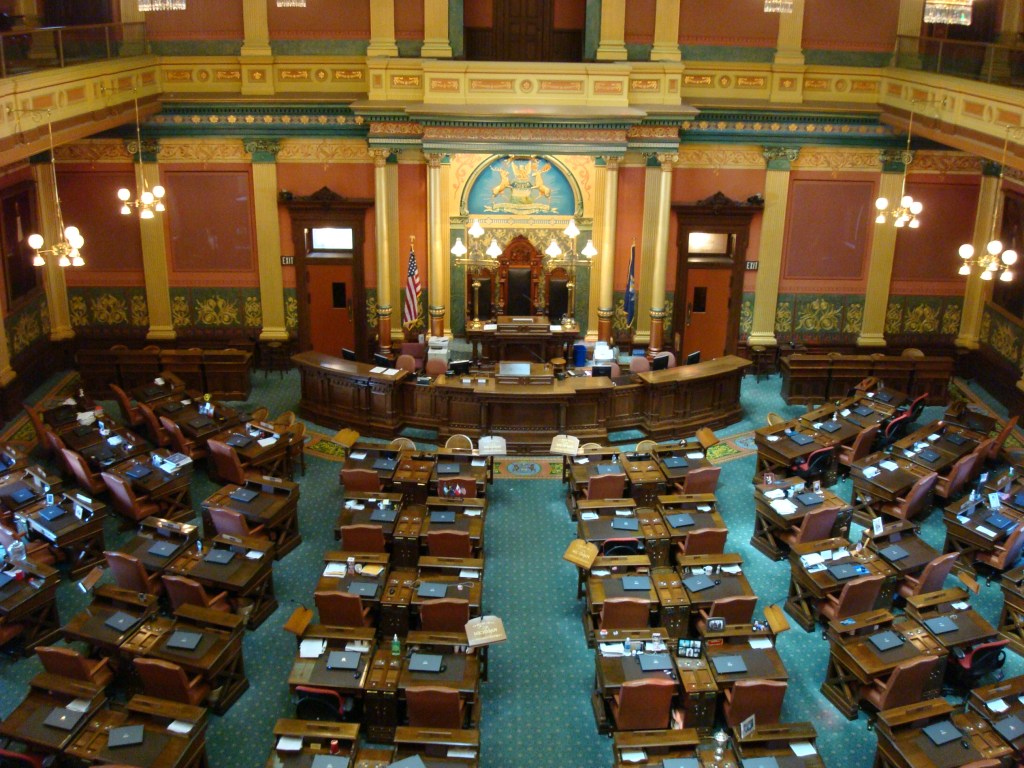
In Michigan, an influential policy broker—here state senator Erika Geiss (D, Taylor)—was able to borrow existing policy language proposed by an arts education coalition, collect new data on gaps in arts education, and leverage political relationships to propose the pilot funding as a one-time appropriation in the state education budget (see State of Michigan, 2023).
A needs assessment showed $22 million was needed for K-5 music programs; $15 million was requested, and $11 million was approved for the 2023 budget (State of Michigan, 2023). This allocation is known as the section 33 music/arts grants.
However, challenges abounded after the passage of the budget allocation. Implementation was marred by a lack of state-level capacity for rollout that limited applications for funding, a short window for grant applications, and other macro-level problems (e.g., unrelated budget fights).
Due to these challenges, only sixteen schools were approved for funding for a total of $2,574,671. Ultimately, this specific music education appropriation was not renewed in the 2024 budget. However, the unused funds (roughly eight million dollars) are part of the 2024-2025 grant allocation.
California
In California, the scope and format of Prop 28 were markedly different from Michigan’s appropriation. Instead of a legislative allocation, voters approved the Arts and Music in Schools Act in November 2022, providing renewable annual funding for the arts. In the 2023-2024 school year, $938 million was allocated for arts education in public schools (Create CA, 2024).
While the $11 million allocation in Michigan was organized by a small group and included in the larger $30 billion education budget with little fanfare, the coalition advocating for Prop 28 was large and vocal. This group included a vocal policy broker who was the main author of Prop 28, the former LAUSD superintendent and former LA deputy mayor, Austin Beutner, alongside the business community, and high-profile musicians and actors (Hubler, 2022).
Implementation of Proposal 28 in California has demonstrated messiness and challenges as well. Although the infrastructure was more organized than in Michigan, both in terms of an organized advocacy coalition (Create CA) and personnel in the department of education, oversight seems to have been lacking.
As a result, teachers union leaders from across the state sent a letter to California Governor Gavin Newsom complaining that numerous districts were incorrectly using Prop 28 funds to supplant existing funding rather than supplementing arts and music instruction as the law required (Los Angeles Times Editorial Board, 2024). Even though districts must report how they spend Prop 28 funds to the state department of education, they seem to have exercised “accounting maneuvers” to allocate money toward existing arts positions and redirect money elsewhere (Jones, 2024).
Summary
As mentioned, any state appropriations for arts education are worthy paying attention to, given their relative rarity. The arts education policy community remains attentive to the implementation of such allocations, given the challenges and chances for success.
References
Americans for the Arts. (2021). Arts education for all act introduced. https://www.americansforthearts.org/news-room/legislative-news/arts-education-for-all-act-introduced
Arts Education Partnership. (2024). ArtScan at a glance. https://www.ecs.org/2024-artscan-at-a-glance/
Arts Education Partnership. (2014). A snapshot of state policies for arts education. https://www.americansforthearts.org/by-program/reports-and-data/legislation-policy/naappd/a-snapshot-of-state-policies-for-arts-education
Create CA. (2024). Prop 28: Arts and Music in Schools planning toolkit. https://createca.org/prop-28-arts-and-music-in-schools-planning-toolkit/?utm_source=ECS+Subscribers&utm_campaign=821a085f3a-ArtsEd_Digest_1242024&utm_medium=email&utm_term=0_1a2b00b930-821a085f3a-53609287
Elpus, K. (2012). Music in U.S. federal education policy: Estimating the effect of “core status” for music. Arts Education Policy Review, 114(1), 13–24. https://doi.org/10.1080/10632913.2013.744242
Hubler, S. (2022, November 2). How Hollywood got behind California’s Prop. 28. The New York Times. https://www.nytimes.com/2022/11/02/us/california-prop-28.html
Jones, C. (2024, May 31). California spent nearly $1 billion to boost arts education. Are schools misspending it? CalMatters. https://calmatters.org/education/k-12-education/2024/05/arts-education/
Koza, J. E. (2010). Essay – When policy disappoints: Still worth less after all these years. Bulletin of the Council for Research in Music Education, 183, 77–95.
Los Angeles Times Editorial Board. (2024, May 16). Editorial: Critics say Prop. 28 arts funding is being misspent. School administrators need to show their work. Los Angeles Times. https://www.latimes.com/opinion/story/2024-05-16/la-proposition-28-school-arts-music-funding
Schmidt, C. M. (1996). Who benefits? Music education and the national standards. Philosophy of Music Education Review, 4(2), 71–82.
Shaw, R. D., & Bernard, C. F. (2023). Appraising metropolitan arts education partnerships: A policy analysis. Arts Education Policy Review, 1–14. https://doi.org/10.1080/10632913.2023.2277941
State of Michigan. (2023). 2023-2024 Section 33 K-5 music programs. https://www.michigan.gov/mde/-/media/Project/Websites/mde/Academic-Standards/Section-33-K-5-Music-Programs/Section_33_Music_Grant_RFP.pdf?rev=0c5b7563a52841978c0cf2f9daed5f3e&hash=1409D463783664796ACFFD5EE09075CB
 The Michigan Music Educator
Leave a comment